
 TonightOnScreen Catalog
Explore Movies • Action
Search our curated catalog of cinema releases, binge-worthy series, and where to stream them.

Oldboy
Directed by South Korean auteur Park Chan-wook as the second and most legendary installment of his celebrated The Vengeance Trilogy, Oldboy (2003) won the Grand Prix at the 2004 Cannes Film Festival, receiving rapturous praise from jury president Quentin Tarantino and permanently cementing the global dominance of modern South Korean cinema. Loosely adapted from the Japanese manga series by Garon Tsuchiya and Nobuaki Minegishi, the narrative begins in 1988 with Oh Dae-su (Choi Min-sik in a volcanic, feral, and emotionally shattering tour de force of method acting), an ordinary, obnoxious businessman and father who is abruptly kidnapped off a rainy street and imprisoned inside a bizarre, windowless hotel room with only a television set for company. Kept alive on fried dumplings and unaware of his captor's identity or motives, Dae-su learns via the TV that his beloved wife has been brutally murdered and that he is the prime suspect. For fifteen agonizing years, Dae-su conditions his body into a lethal weapon through shadowboxing against the wallpaper, feeding an insatiable hunger for retribution. Without warning, he is suddenly released inside a suitcase on a grassy rooftop, handed cash and a mobile phone, and given exactly five days by his enigmatic, wealthy captor Lee Woo-jin (Yoo Ji-tae) to solve the mystery: not why he was imprisoned for fifteen years, but why he was let go. Aided by a sympathetic young sushi chef named Mi-do (Kang Hye-jung), Dae-su embarks on a blood-drenched odyssey through Seoul's underworld, famously culminating in the legendary three-minute single-take side-scrolling corridor brawl where Dae-su battles dozens of armed thugs with only a claw hammer. Featuring Cho Young-wuk's lush, melancholic waltz soundtrack and Chung Chung-hoon's green-tinted cinematography, Oldboy is an operatic Greek tragedy of revenge, guilt, and devastating cosmic irony.

Vada Chennai
Directed by Vetrimaaran, the 2018 epic crime drama Vada Chennai (North Madras) is widely celebrated as one of the most intricately written, authentic, and culturally profound gangster epics in Indian cinema history, grossing over ₹75 crore and earning massive cult status. Spanning three decades from 1987 to the late 2000s in the working-class coastal neighborhood of North Chennai, the film stars Dhanush in a career-best, tour de force performance as Anbu, a skilled carrom player who aspires to become a national champion and stay away from street crime. However, Anbu is inexorably drawn into a complex web of gang warfare between rival underworld factions led by Guna (Samuthirakani) and Senthil (Kishore). The narrative unspools the legendary history of Rajan (Ameer in an iconic, magnetic turn), a righteous fisherman and community protector whose betrayal and murder ignited a thirty-year cycle of blood. When corporate real estate projects threaten to displace his slum community, Anbu embraces his destiny as their leader. Featuring Santhosh Narayanan's electrifying folk score, Vada Chennai is an undisputed cinematic milestone. Vetrimaaran's immersive world-building, sprawling multi-decade non-linear narrative, Santhosh Narayanan's atmospheric musical landscape, and an ensemble cast featuring Andrea Jeremiah and Samuthirakani establish Vada Chennai as an epic milestone in realistic Tamil crime cinema.

Asuran
Directed by master auteur Vetrimaaran and adapted from Poomani's novel Vekkai, the 2019 Tamil rural action-drama Asuran won two National Film Awards—Best Feature Film in Tamil and Best Actor for Dhanush—standing as one of the most intense, critically acclaimed masterworks of Indian cinema. Set in the drought-prone rural heartland of Tirunelveli in the 1980s, Dhanush delivers a monumental, career-best dual performance as Sivasaami, an oppressed, aging Dalit farmer who grovels before upper-caste landlords to protect his small patch of land and keep his family safe. When his hot-headed elder son Murugan is murdered and his younger son Chidambaram (Ken Karunas) decapitates the wealthy, casteist landlord Vadakkooran in retaliation, Sivasaami flees with his son into the barren scrublands. As hunting parties pursue them, Sivasaami's past is revealed: in his youth, he was a ferocious, unstoppable warrior who fought for land rights before losing his family in an inferno. Sivasaami's ultimate lesson to his son—that education is the only wealth the oppressors can never steal—remains one of the most powerful political messages in world cinema. Dhanush won his second National Film Award for Best Actor for his volcanic performance, while Vetrimaaran's unflinching staging and G.V. Prakash Kumar's fiery musical score elevate Asuran into a searing, globally acclaimed masterpiece on systemic caste oppression and paternal sacrifice.

Kaithi
Directed by Lokesh Kanagaraj, the 2019 neo-noir action thriller Kaithi is the foundational cornerstone of the Lokesh Cinematic Universe (LCU), achieving massive critical acclaim and grossing over ₹105 crore without containing a single song, dance sequence, or romantic subplot. Set entirely over the course of one terrifying, rain-soaked night in Tiruchirappalli, the story begins when honest police inspector Bejoy (Narain) seizes 900 kilograms of raw cocaine belonging to dangerous drug lord Adaikalam. In retaliation, Adaikalam's gang drugs forty high-ranking police officers at an IG retirement party. With every ambulance disabled and officers dying, Bejoy's only hope is Dilli (Karthi in a career-defining, powerhouse performance)—a quiet, heavily built paroled prisoner who has just completed a ten-year prison sentence and is traveling to an orphanage to see his 10-year-old daughter Amudha for the first time in his life. Driving a giant lorry filled with unconscious cops across gang-infested highways, Dilli must overcome lethal blockades, leading to a legendary Gatling-gun siege at a police station. Packed with raw stunt choreography and Sam C.S.'s score, Kaithi is an action masterclass.

Aliens
Written and directed by James Cameron, the 1986 action sci-fi juggernaut Aliens accomplished the rare cinematic feat of expanding Ridley Scott's slow-burn horror classic into an explosive, relentless military combat spectacle that earned seven Academy Award nominations—including a historic Best Actress nomination for Sigourney Weaver. Rescued after 57 years of cryo-sleep floating in hyperspace, a traumatized Ellen Ripley (Weaver) learns that LV-426 has been terraformed into a civilian mining colony named Hadley's Hope. When contact with the colony is suddenly lost, the Weyland-Yutani Corporation recruits Ripley as an advisor to accompany a squad of cocky, heavily armed Colonial Marines led by Corporal Hicks (Michael Biehn), Private Hudson (Bill Paxton), and android Bishop (Lance Henriksen). Arriving on the atmospheric moon, the soldiers find the colony decimated and encounter a hive of hundreds of Xenomorphs. Adopting a traumatized orphan girl named Newt, Ripley transforms into an unstoppable, maternal warrior, strapping a pulse rifle to a flamethrower and climbing into a yellow Caterpillar hydraulic Power Loader to battle the towering Alien Queen with the immortal battle cry: 'Get away from her, you bitch!' Aliens stands as an unyielding masterclass in action cinema.

Spider-Man: Into the Spider-Verse
Directed by Bob Persichetti, Peter Ramsey, and Rodney Rothman and produced by Phil Lord and Christopher Miller, Sony Pictures Animation's Spider-Man: Into the Spider-Verse fundamentally revolutionized modern cinematic animation, capturing the Academy Award for Best Animated Feature. Centered on Miles Morales (Shameik Moore), an Afro-Latino Brooklyn teenager struggling with parental expectations and identity at a prestigious boarding school, Miles's life changes forever when he is bitten by a radioactive spider and witnesses the tragic death of Peter Parker at the hands of Kingpin (Liev Schreiber). Kingpin's subterranean Super-Collider tears open the fabric of the multiverse, pulling five alternative Spider-heroes into Miles's dimension: a jaded, sweatpants-wearing middle-aged Peter B. Parker (Jake Johnson), rebellious punk-rock Gwen Stacy / Spider-Woman (Hailee Steinfeld), 1930s black-and-white private eye Spider-Man Noir (Nicolas Cage), anime schoolgirl Peni Parker, and cartoon pig Peter Porker / Spider-Ham. Inventing a groundbreaking visual grammar that synthesizes traditional hand-drawn comic book halftone Ben-Day dots, dynamic graffiti, and hip-hop beats, Miles's iconic 'Leap of Faith' off a skyscraper symbolizes pure courage and representation: 'Anyone can wear the mask. You could wear the mask.'
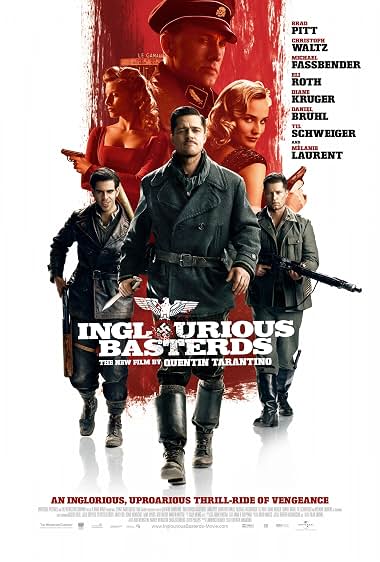
Inglourious Basterds
Quentin Tarantino's revisionist historical war masterpiece Inglourious Basterds is a dialogue-driven, pulse-pounding alternate-history triumph that famously rewrites the end of World War II inside a Parisian cinema. In Nazi-occupied France, Jewish refugee Shosanna Dreyfus (Mélanie Laurent) witnesses the massacre of her family by the urbane, terrifying SS Colonel Hans Landa (Christoph Waltz, who swept every major acting award on earth, including the Oscar and Cannes Best Actor). Fleeing to Paris, Shosanna assumes a new identity as a cinema proprietor and plots a lethal trap when Nazi high command selects her theater to premiere Joseph Goebbels' propaganda epic. Simultaneously, Lieutenant Aldo Raine (Brad Pitt) leads the 'Basterds'—a ruthless commando squad of Jewish-American soldiers who scalp Nazis and strike terror through the Reich. Collaborating with British intelligence officer Archie Hicox (Michael Fassbender) and German movie star double-agent Bridget von Hammersmark (Diane Kruger), the two revenge plots converge in a blazing, silver-nitrate inferno. Boasting legendary masterclass suspense scenes like the opening French farmhouse interrogation and the subterranean tavern card game, Inglourious Basterds is an unmissable cinematic triumph.

The Dark Knight Rises
Christopher Nolan brought his historic, genre-redefining Dark Knight Trilogy to a thunderous, operatic conclusion with 2012's epic blockbuster The Dark Knight Rises. Eight years after taking the blame for District Attorney Harvey Dent's crimes and vanishing into the shadows, a physically broken and reclusive Bruce Wayne (Christian Bale) lives in seclusion in Wayne Manor, while Gotham City enjoys a fragile peace under the strict Dent Act. However, the arrival of enigmatic, agile cat burglar Selina Kyle (Anne Hathaway as a dazzling Catwoman) and the emergence of Bane (a physically imposing, muffled-voiced Tom Hardy), a masked revolutionary terrorist excommunicated from the League of Shadows, plunges Gotham into existential crisis. Bane brutally breaks Batman's spine in sewer combat, casts Bruce into a subterranean Middle Eastern prison pit, and detonates Gotham's bridges, holding the island city hostage with a neutron bomb in a reign of populist terror. Bruce must conquer his inner trauma to make the legendary climb to freedom, returning to save Gotham alongside Commissioner Gordon (Gary Oldman) and idealistic cop John Blake (Joseph Gordon-Levitt). Grossing over $1.08 billion, the film is a monumental, Hans Zimmer-scored triumph of sacrifice and heroic redemption.

Avengers: Endgame
Directed by Anthony and Joe Russo, Marvel Studios' monumental superhero event Avengers: Endgame served as the breathtaking culmination of the 22-film Infinity Saga, shattering global box office records with an unprecedented $2.799 billion worldwide haul. Picking up in the devastating aftermath of Thanos's (Josh Brolin) catastrophic snap that eradicated fifty percent of all living creatures in the universe, the surviving, grief-stricken Avengers—Tony Stark / Iron Man (Robert Downey Jr.), Steve Rogers / Captain America (Chris Evans), Thor (Chris Hemsworth), Bruce Banner / Hulk (Mark Ruffalo), Natasha Romanoff / Black Widow (Scarlett Johansson), and Clint Barton / Hawkeye (Jeremy Renner)—are shattered. Five years later, the unexpected reappearance of Scott Lang / Ant-Man (Paul Rudd) from the Quantum Realm ignites an audacious glimmer of hope: a desperate, high-stakes 'Time Heist' to retrieve the Infinity Stones from past timelines. The narrative weaves an emotionally powerful victory lap through Marvel Cinematic Universe history, culminating in an awe-inspiring, stadium-shaking final battle at the ruined Avengers compound where generations of resurrected heroes assemble. Powered by Alan Silvestri's triumphant score and Robert Downey Jr.'s tear-jerking, sacrificial finale, Endgame stands as an unprecedented cultural milestone in blockbuster entertainment.
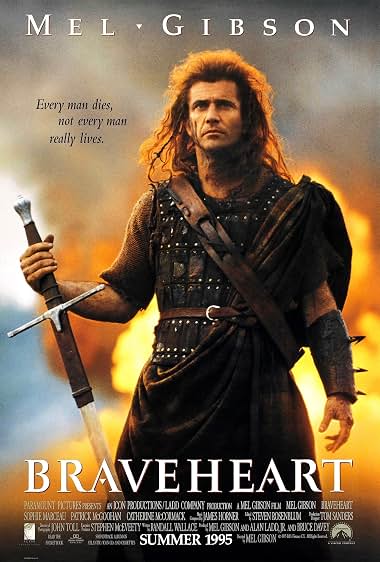
Braveheart
Directed, produced, and starring Mel Gibson in an unforgettable display of visceral cinematic passion, Braveheart (1995) stands as one of the most magnificent, emotionally soaring, and legendary historical warfare epics ever committed to celluloid, sweeping five Academy Awards including Best Picture and Best Director. Dramatizing the First War of Scottish Independence in the late thirteenth century, the film chronicles the mythic rise of William Wallace (Mel Gibson in a career-defining, ferocious, and heart-stirring performance), a humble Scottish highlander seeking a quiet rural existence after witnessing English tyranny as a child. When his secret bride Murron MacClannough is barbarically executed by the cruel English garrison commander of Lanark, Wallace's agonizing grief ignites an incandescent revolution of liberation. Uniting fractured Scottish highland clans through moral conviction, ferocious guerrilla warfare, and martial genius, Wallace leads his ragtag army of kilt-clad farmers to a miraculous, earth-shaking victory against the superior royal legions of England's ruthless King Edward I 'Longshanks' (Patrick McGoohan) at the Battle of Stirling Bridge. Before the thunderous clash of broadswords, Wallace delivers the single most iconic motivational speech in screen history, roaring across the green fields of Scotland: 'They may take our lives, but they'll never take our freedom!' As Wallace navigates royal palace intrigue alongside the compassionate French Princess Isabelle (Sophie Marceau) and confronts devastating aristocratic treachery from Scottish nobles at the Battle of Falkirk, his unwavering spirit remains unyielding. Captured and subjected to public torture in London, Wallace refuses to submit, using his final dying breath to roar 'Freedom!' into the heavens. Scored by James Horner's haunting Celtic Uilleann pipes and lensed with breathtaking grandeur by John Toll, Braveheart is an immortal testament to sacrificial patriotism, love, and the indomitable power of human liberty.
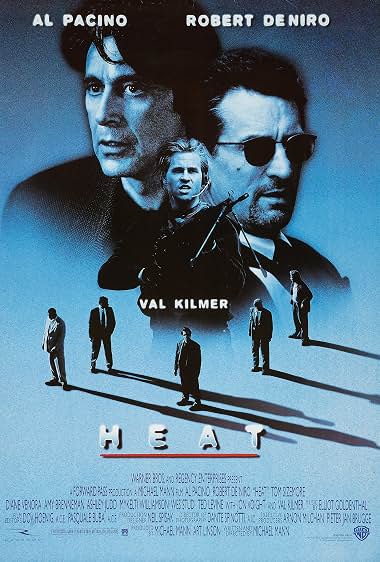
Heat
Written and directed by visionary filmmaker Michael Mann, Heat (1995) is widely revered by critics and filmmakers as the undisputed crown jewel of modern urban crime cinema and the ultimate heist epic. Marking the historic first on-screen pairing of cinema titans Al Pacino and Robert De Niro, the film is an operatic, multi-layered existential duel staged across the sleek, neon-drenched glass and concrete architecture of contemporary Los Angeles. De Niro portrays Neil McCauley, a cold, ascetic master thief who lives by a strict professional survival code: 'Don't let yourself get attached to anything you are not willing to walk out on in 30 seconds flat if you feel the heat around the corner.' Pacino plays Lieutenant Vincent Hanna, an obsessive, hyper-caffeinated LAPD robbery-homicide detective whose relentless pursuit of high-end predators has wrecked his third marriage. When McCauley's crew—including Val Kilmer and Tom Sizemore—pulls off a bloody armored car heist, Hanna locks onto their trail, sparking an intellectual and tactical chess match between two mirrored men who recognize each other as two sides of the same driven coin. Their legendary, understated conversation over coffee at Kate Mantilini diner remains one of the greatest dramatic scenes in Hollywood history. Culminating in a breathtaking, thunderous 10-minute daylight downtown bank shootout with authentic, non-foley live gunfire echoes and an atmospheric climax under the runway lights of LAX, Dante Spinotti's cinematography and Elliot Goldenthal's ambient score elevate Heat into an immortal American tragedy on obsession, discipline, and loneliness.

Satya
Ram Gopal Varma's 1998 underworld masterpiece Satya fundamentally destroyed the glamorous, melodramatic conventions of Bollywood cinema, pioneering the realistic, gritty 'Mumbai Noir' movement and winning six Filmfare Awards and a National Film Award. Co-written by Anurag Kashyap and Saurabh Shukla, the film follows Satya (J.D. Chakravarthy), an innocent, jobless immigrant from South India who arrives in Mumbai seeking honest work. Falsely implicated in a restaurant bar fight and brutalized in jail, Satya befriends the charismatic, uninhibited gangster Bhiku Mhatre (Manoj Bajpayee in an explosive, legendary performance that made him an overnight star). Released into Mhatre's underworld syndicate, Satya's sharp intellect and fearless efficiency quickly elevate him to the gang's mastermind strategist, waging war against rival boss Guru Narayan. Satya's burgeoning romance with his naive neighbor Vidya (Urmila Matondkar) represents his dream of redemption, but the arrival of ruthless Police Commissioner Amod Shukla (Paresh Rawal) triggers an unavoidable, blood-soaked tragedy. With Vishal Bhardwaj's visceral score ('Sapne Mein Milti Hai') and Gerard Hooper's handheld camera, Satya changed Indian cinema forever.