
 TonightOnScreen Catalog
Explore Entertainment • Thriller
Search our curated catalog of cinema releases, binge-worthy series, and where to stream them.
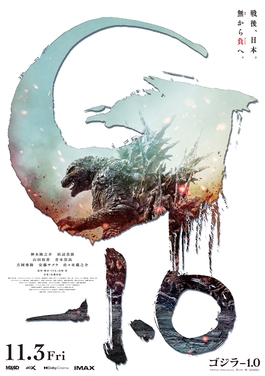
Godzilla Minus Zero
<p><strong>Godzilla Minus Zero</strong> (ゴジラ マイナス ゼロ) is the monumental direct sequel to the Academy Award-winning international phenomenon <a href="/title/godzilla-minus-one-2023">Godzilla Minus One</a>, written, directed, and visual effects-supervised by acclaimed visionary <a href="/person/takashi-yamazaki">Takashi Yamazaki</a>.</p><p>Set in 1954 as Japan strives to rebuild its war-torn infrastructure and enter the modern industrial era, the peace achieved by former kamikaze pilot Koichi Shikishima (<a href="/person/ryunosuke-kamiki">Ryunosuke Kamiki</a>) and his family is shattered. A mysterious biological sample retrieved from the depths of Tokyo Bay displays rapid, uncontrollable regenerative cell multiplication. At the same time, Noriko Oishi (<a href="/person/minami-hamabe">Minami Hamabe</a>) begins experiencing strange physical symptoms connected to the black cellular mark on her neck. When deep ocean seismic sensors detect an immense thermal surge moving toward the Japanese archipelago, a larger, more terrifying atomic titan emerges from the icy abyss, forcing ordinary citizens and veteran engineers to unite once more in a desperate battle for survival.</p>
The Samurai and the Prisoner
<p><strong>The Samurai and the Prisoner</strong> (侍と囚人) is a gripping, historically authentic Japanese Jidaigeki samurai suspense thriller that combines the moral gravity of classic Bushido literature with the airtight deduction of a classic locked-room mystery.</p><p>Set in 1688 during the frosty winter of the Genroku period in the mountainous Echigo province. Inside a heavily fortified castle, a respected clan elder is discovered poisoned inside a snow-surrounded tea pavilion that was barred from the inside with no footprints leaving the perimeter. The sole person found hiding in the castle attic is Genkuro, a silent, one-armed wandering ronin who refuses to speak or plead for his life. With clan elders demanding a swift public execution, honorable magistrate samurai Jurozaemon is granted exactly thirty days to interrogate the prisoner, verify his guilt, and prevent an all-out civil war between rival retainer clans. Through fierce psychological duels across iron bars, Jurozaemon begins to suspect that the prisoner is not a ruthless assassin, but a guardian protecting an explosive secret that could shatter the Tokugawa shogunate.</p>

Oldboy
Directed by South Korean auteur Park Chan-wook as the second and most legendary installment of his celebrated The Vengeance Trilogy, Oldboy (2003) won the Grand Prix at the 2004 Cannes Film Festival, receiving rapturous praise from jury president Quentin Tarantino and permanently cementing the global dominance of modern South Korean cinema. Loosely adapted from the Japanese manga series by Garon Tsuchiya and Nobuaki Minegishi, the narrative begins in 1988 with Oh Dae-su (Choi Min-sik in a volcanic, feral, and emotionally shattering tour de force of method acting), an ordinary, obnoxious businessman and father who is abruptly kidnapped off a rainy street and imprisoned inside a bizarre, windowless hotel room with only a television set for company. Kept alive on fried dumplings and unaware of his captor's identity or motives, Dae-su learns via the TV that his beloved wife has been brutally murdered and that he is the prime suspect. For fifteen agonizing years, Dae-su conditions his body into a lethal weapon through shadowboxing against the wallpaper, feeding an insatiable hunger for retribution. Without warning, he is suddenly released inside a suitcase on a grassy rooftop, handed cash and a mobile phone, and given exactly five days by his enigmatic, wealthy captor Lee Woo-jin (Yoo Ji-tae) to solve the mystery: not why he was imprisoned for fifteen years, but why he was let go. Aided by a sympathetic young sushi chef named Mi-do (Kang Hye-jung), Dae-su embarks on a blood-drenched odyssey through Seoul's underworld, famously culminating in the legendary three-minute single-take side-scrolling corridor brawl where Dae-su battles dozens of armed thugs with only a claw hammer. Featuring Cho Young-wuk's lush, melancholic waltz soundtrack and Chung Chung-hoon's green-tinted cinematography, Oldboy is an operatic Greek tragedy of revenge, guilt, and devastating cosmic irony.
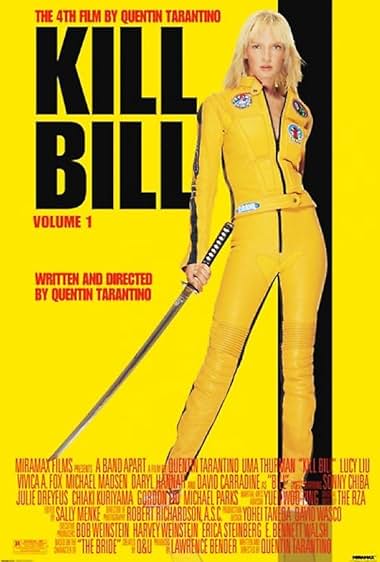
Kill Bill: Vol. 1
Written and directed with kinetic pop-culture virtuosity and blood-drenched martial arts reverence by Quentin Tarantino, Kill Bill: Vol. 1 (2003) is universally celebrated as one of the most stylish, iconic, and exhilarating revenge action epics in cinematic history, grossing over $180 million worldwide. Conceived as a passionate love letter to 1970s Shaw Brothers kung fu cinema, Japanese samurai chambara, spaghetti westerns, and anime, the narrative follows Beatrix Kiddo, universally known as 'The Bride' or 'Black Mamba' (Uma Thurman in a magnificent, physical, and emotionally fierce tour de force of martial arts mastery). A former elite assassin belonging to the deadly Deadly Viper Assassination Squad, The Bride is betrayed on her wedding rehearsal day in a rural El Paso chapel, where her treacherous mentor and former lover Bill (David Carradine) and her former squad colleagues slaughter her unborn child, fiancé, and guests, leaving her for dead with a bullet in her brain. Awakening from a four-year comatose slumber in a hospital, The Bride embarks on a relentless global crusade of vengeance, compiling a five-name hit list. Traveling to Okinawa to acquire a priceless, razor-sharp Hattori Hanzo katana forged by a legendary master swordsmith (Sonny Chiba), The Bride tracks her first target, Yakuza crime queen O-Ren Ishii (Lucy Liu), to the lavish House of Blue Leaves restaurant in Tokyo. There, she single-handedly decimates the Crazy 88 sword gang in a breathtaking, fountain-of-blood brawl and slashes through bodyguard Gogo Yubari, culminating in an ethereal, snowbound zen duel. Featuring an iconic yellow-and-black tracksuit tribute to Bruce Lee and Production I.G's violent anime sequence, Kill Bill: Vol. 1 is an undisputed action masterpiece.
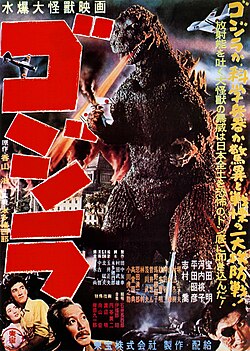
Godzilla
Godzilla (1954) is the seminal, historically monumental, and emotionally devastating original Japanese kaiju masterpiece directed by Ishirō Honda, which not only launched the world's longest-running film franchise but stands as a profound, heartbreaking allegory for Japan's nuclear trauma, the destruction of Hiroshima and Nagasaki, and the terrifying psychological aftermath of the atomic age. When Japanese fishing vessels near Odo Island are suddenly incinerated and capsized by a mysterious, catastrophic force accompanied by massive flooding, investigators discover that the destruction matches no known natural phenomenon. A prehistoric, radioactively awakened leviathan — Godzilla — emerges from the depths of Tokyo Bay, making its first landfall in Tokyo during a harrowing nighttime rampage of incomprehensible scale, obliterating the city's infrastructure with atomic breath and thundering footsteps as civilians are incinerated in their tens of thousands. The narrative centers on Dr. Kyohei Yamane, a paleontologist who believes Godzilla must be studied rather than destroyed as a living relic of prehistory; his daughter Emiko; her fiancé, the disillusioned biologist Dr. Serizawa who has developed a terrifying and morally catastrophic secret weapon called the Oxygen Destroyer; and Naval officer Hideto Ogata, who loves Emiko. As Tokyo burns and the Japanese government debates military versus scientific response, the moral weight of deploying Serizawa's annihilation weapon — a device so powerful it could end all ocean life — forms the film's devastating ethical core. Honda's somber masterpiece gave voice to an entire generation's collective nuclear horror, creating cinema's most iconic monster as a metaphor for mankind's most dangerous invention.
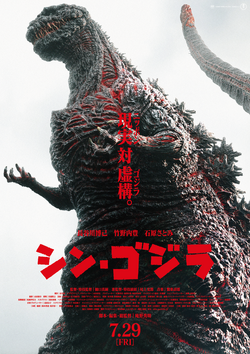
Shin Godzilla
Shin Godzilla is a darkly satirical, politically electrifying, and visually audacious kaiju reimagining co-directed by Hideaki Anno and Shinji Higuchi, winner of seven Japan Academy Film Awards including Best Picture and Best Director — marking the first Godzilla film to win Japan's most prestigious cinematic honors and the most critically acclaimed Japanese giant monster film since the 1954 original. Rather than focusing on military spectacle or human adventure, Anno's singular creative vision delivers a bracingly incisive dissection of Japanese government bureaucracy, institutional paralysis, and post-disaster crisis management that functions simultaneously as monster cinema and scathing political satire. When Tokyo Bay erupts in violent geothermal upheaval and a previously unknown, grotesquely mutating living organism begins crawling ashore through Kamakura, the Japanese government's multi-layered committee system collapses into paralytic jurisdictional disputes, procedural deadlock, and bureaucratic comedy as officials desperately attempt to determine which ministry has authority over an unprecedented biological kaiju. The creature — evolving through increasingly horrifying forms — rapidly mutates into Godzilla: a towering, asymmetrical, malformed, radiation-emitting behemoth covered in grotesque gill-like slashes, with a disturbingly humanoid face and the most visually unsettling design in franchise history. Godzilla's atomic breath sequence in Shinjuku — a silent, blinding column of white heat that obliterates skyscrapers in an instant before he goes dormant — is widely regarded as the most terrifying and artistically striking Godzilla moment in the entire franchise. The human story centers on Deputy Chief Cabinet Secretary Rando Yaguchi, who assembles an unconventional interdisciplinary task force to defeat Godzilla before American tactical nuclear strikes obliterate Tokyo.
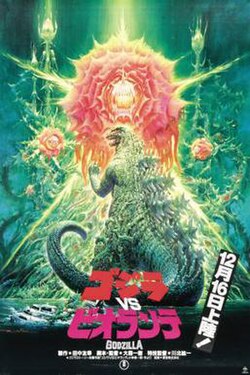
Godzilla vs. Biollante
Godzilla vs. Biollante is the most emotionally complex, scientifically ambitious, and hauntingly beautiful entry in the entire Heisei Godzilla series, directed by Kazuki Ōmori, weaving Cold War espionage thriller, ethical bioengineering debate, and tragic parental grief into a monster narrative of unprecedented psychological depth. Following the catastrophic 1984 Tokyo battle against Godzilla, the Japanese government's Godzilla Prediction Network extracts cellular G-Cells from the monster's cooling trail — cells of extraordinary genetic resilience with potential military and agricultural applications. The G-Cells become the target of an international bioengineering arms race between Japan's SSS9 anti-G biological warfare unit, the sinister Saradia Oil States Corporation, and the ruthless international espionage network. Brilliant biogeneticist Dr. Genshiro Shiragami, consumed by grief over his daughter Erika's death in a terrorist bombing, has been secretly fusing her cellular DNA with a rose — the flower she most loved — to preserve her spirit within the living plant. When the Saradia Organization threatens to steal his G-Cell research, Shiragami makes the agonizing decision to splice Erika's gene-fused rose cells with Godzilla's G-Cells, creating Biollante — a magnificent, nightmarish, and heartbreakingly beautiful hybrid creature that manifests first as a colossal luminous rose and later transforms into a devastating, tentacled, acid-spitting leviathan. As Godzilla is lured from volcanic imprisonment back to Japan, the moral weight of Biollante's existence — a grieving father's love twisted into a monster — gives the climactic battle a tragic, Frankenstein-esque dimension. A genuinely unique and intellectually resonant achievement in monster cinema.