
 TonightOnScreen Catalog
Explore Entertainment
Search our curated catalog of cinema releases, binge-worthy series, and where to stream them.

Iruvar
Directed, produced, and co-written by maestro Mani Ratnam alongside Suhasini Maniratnam, 1997's Tamil political epic drama Iruvar (The Duo) won the Best Film award at the Belgrade International Film Festival, captured two National Film Awards, and is universally revered by critics, film scholars, and cinephiles as Mani Ratnam's magnum opus and one of the most sophisticated political masterworks ever filmed in world cinema. Dramatizing the historic, complex symbiotic friendship and subsequent political rivalry between iconic actor-turned-Chief Minister M.G. Ramachandran (MGR) and celebrated writer-politician M. Karunanidhi in Tamil Nadu, the film explores how cinema and mass politics became inextricably intertwined in modern Indian democracy. Mohanlal delivers one of the most charismatic, effortlessly regal, and nuanced performances of his legendary career as Anandan, a struggling film extra whose irresistible screen presence, swordsmanship, and populist appeal transform him into an immortal cinematic demi-god. Prakash Raj delivers a fiery, Shakespearean, and National Award-winning performance as Tamizhselvan, a passionate, atheist Dravidian poet and orator whose lyrical scripts and socialist rhetoric propel Anandan to silver-screen stardom. Uniting under a shared revolutionary political party led by a venerable leader (Nassar as Ayya Veluthambi), the duo utilizes the power of cinema to mobilize millions of working-class voters. However, as their political movement seizes state power, ideological fractures, personal vanity, and mutual jealousy sever their bond, turning former brothers into bitter electoral adversaries. Marking the sensational cinematic acting debut of Aishwarya Rai in a dual role, Santosh Sivan's revolutionary fluid camerawork and A.R. Rahman's jazz-and-classical score cement Iruvar as an immortal masterpiece of power, cinema, and friendship.

Oldboy
Directed by South Korean auteur Park Chan-wook as the second and most legendary installment of his celebrated The Vengeance Trilogy, Oldboy (2003) won the Grand Prix at the 2004 Cannes Film Festival, receiving rapturous praise from jury president Quentin Tarantino and permanently cementing the global dominance of modern South Korean cinema. Loosely adapted from the Japanese manga series by Garon Tsuchiya and Nobuaki Minegishi, the narrative begins in 1988 with Oh Dae-su (Choi Min-sik in a volcanic, feral, and emotionally shattering tour de force of method acting), an ordinary, obnoxious businessman and father who is abruptly kidnapped off a rainy street and imprisoned inside a bizarre, windowless hotel room with only a television set for company. Kept alive on fried dumplings and unaware of his captor's identity or motives, Dae-su learns via the TV that his beloved wife has been brutally murdered and that he is the prime suspect. For fifteen agonizing years, Dae-su conditions his body into a lethal weapon through shadowboxing against the wallpaper, feeding an insatiable hunger for retribution. Without warning, he is suddenly released inside a suitcase on a grassy rooftop, handed cash and a mobile phone, and given exactly five days by his enigmatic, wealthy captor Lee Woo-jin (Yoo Ji-tae) to solve the mystery: not why he was imprisoned for fifteen years, but why he was let go. Aided by a sympathetic young sushi chef named Mi-do (Kang Hye-jung), Dae-su embarks on a blood-drenched odyssey through Seoul's underworld, famously culminating in the legendary three-minute single-take side-scrolling corridor brawl where Dae-su battles dozens of armed thugs with only a claw hammer. Featuring Cho Young-wuk's lush, melancholic waltz soundtrack and Chung Chung-hoon's green-tinted cinematography, Oldboy is an operatic Greek tragedy of revenge, guilt, and devastating cosmic irony.
Taare Zameen Par
Produced and directed by Aamir Khan and written by Amole Gupte, the 2007 emotional family drama Taare Zameen Par (Like Stars on Earth) stands as a watershed cultural touchstone in Indian cinema, winning the National Film Award for Best Film on Family Welfare and three Filmfare Awards including Best Film and Best Director. The story centers on eight-year-old Ishaan Nandkishore Awasthi (Darsheel Safary in one of the most astonishing child performances in world cinema), an imaginative, artistic boy whose world is filled with vibrant colors, animated fishes, and flying kites. However, Ishaan struggles terribly with reading, writing, and numbers, leading his strict, competitive corporate father to brand him as lazy and defiant, ultimately exiling him to a harsh, disciplinarian boarding school where Ishaan sinks into severe depression and silence. Ishaan's life is transformed forever with the arrival of Ram Shankar Nikumbh (Aamir Khan), an empathetic, unconventional art teacher at the Tulips School for children with developmental disabilities. Recognizing that Ishaan suffers from dyslexia—a neurological learning difficulty—Nikumbh breaks societal taboos, confronts the school board, and dedicates himself to nurturing Ishaan's unique creative brilliance through patient phonetics and art. Featuring Shankar-Ehsaan-Loy's tear-inducing anthem 'Maa', Taare Zameen Par is an inspirational, deeply moving cinematic masterpiece that fundamentally altered parental consciousness and educational reform across India.
Apocalypse Now
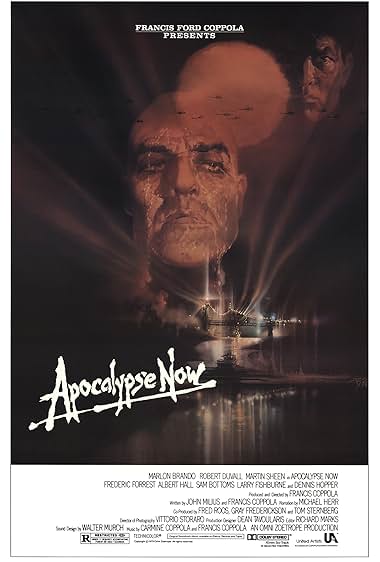
Francis Ford Coppola's monumental 1979 war epic Apocalypse Now is widely celebrated as one of the most audacious, visually hypnotic, and philosophically searing achievements in world cinema, capturing the Palme d'Or at the Cannes Film Festival and two Academy Awards. Inspired by Joseph Conrad's 1899 novella Heart of Darkness and transplanted to the harrowing quagmire of the Vietnam War, the narrative follows U.S. Army Captain Benjamin L. Willard (Martin Sheen), a haunted, psychologically broken intelligence operative dispatched on a classified, clandestine mission up the surreal Nung River into remote neutral Cambodia. His terrifying objective is to locate and 'terminate with extreme prejudice' renegade Special Forces Colonel Walter E. Kurtz (Marlon Brando in an iconic, shadow-drenched performance of mythic madness), who has gone rogue, rejected military command, and established a barbaric tribal kingdom in the jungle. Navigating through hallucinatory war zones, surfing obsession under the manic Lieutenant Colonel Kilgore (Robert Duvall roaring 'I love the smell of napalm in the morning'), and drug-fueled madness, Willard's perilous journey upriver serves as a descent into the darkest abysses of the human psyche, imperialist hubris, and primal insanity. Vittorio Storaro's revolutionary cinematography, combined with Walter Murch's pioneering multi-channel sound design, cements Apocalypse Now as a hallucinatory, unforgettable triumph on the moral decay of war.

Vada Chennai
Directed by Vetrimaaran, the 2018 epic crime drama Vada Chennai (North Madras) is widely celebrated as one of the most intricately written, authentic, and culturally profound gangster epics in Indian cinema history, grossing over ₹75 crore and earning massive cult status. Spanning three decades from 1987 to the late 2000s in the working-class coastal neighborhood of North Chennai, the film stars Dhanush in a career-best, tour de force performance as Anbu, a skilled carrom player who aspires to become a national champion and stay away from street crime. However, Anbu is inexorably drawn into a complex web of gang warfare between rival underworld factions led by Guna (Samuthirakani) and Senthil (Kishore). The narrative unspools the legendary history of Rajan (Ameer in an iconic, magnetic turn), a righteous fisherman and community protector whose betrayal and murder ignited a thirty-year cycle of blood. When corporate real estate projects threaten to displace his slum community, Anbu embraces his destiny as their leader. Featuring Santhosh Narayanan's electrifying folk score, Vada Chennai is an undisputed cinematic milestone. Vetrimaaran's immersive world-building, sprawling multi-decade non-linear narrative, Santhosh Narayanan's atmospheric musical landscape, and an ensemble cast featuring Andrea Jeremiah and Samuthirakani establish Vada Chennai as an epic milestone in realistic Tamil crime cinema.

Asuran
Directed by master auteur Vetrimaaran and adapted from Poomani's novel Vekkai, the 2019 Tamil rural action-drama Asuran won two National Film Awards—Best Feature Film in Tamil and Best Actor for Dhanush—standing as one of the most intense, critically acclaimed masterworks of Indian cinema. Set in the drought-prone rural heartland of Tirunelveli in the 1980s, Dhanush delivers a monumental, career-best dual performance as Sivasaami, an oppressed, aging Dalit farmer who grovels before upper-caste landlords to protect his small patch of land and keep his family safe. When his hot-headed elder son Murugan is murdered and his younger son Chidambaram (Ken Karunas) decapitates the wealthy, casteist landlord Vadakkooran in retaliation, Sivasaami flees with his son into the barren scrublands. As hunting parties pursue them, Sivasaami's past is revealed: in his youth, he was a ferocious, unstoppable warrior who fought for land rights before losing his family in an inferno. Sivasaami's ultimate lesson to his son—that education is the only wealth the oppressors can never steal—remains one of the most powerful political messages in world cinema. Dhanush won his second National Film Award for Best Actor for his volcanic performance, while Vetrimaaran's unflinching staging and G.V. Prakash Kumar's fiery musical score elevate Asuran into a searing, globally acclaimed masterpiece on systemic caste oppression and paternal sacrifice.

Kaithi
Directed by Lokesh Kanagaraj, the 2019 neo-noir action thriller Kaithi is the foundational cornerstone of the Lokesh Cinematic Universe (LCU), achieving massive critical acclaim and grossing over ₹105 crore without containing a single song, dance sequence, or romantic subplot. Set entirely over the course of one terrifying, rain-soaked night in Tiruchirappalli, the story begins when honest police inspector Bejoy (Narain) seizes 900 kilograms of raw cocaine belonging to dangerous drug lord Adaikalam. In retaliation, Adaikalam's gang drugs forty high-ranking police officers at an IG retirement party. With every ambulance disabled and officers dying, Bejoy's only hope is Dilli (Karthi in a career-defining, powerhouse performance)—a quiet, heavily built paroled prisoner who has just completed a ten-year prison sentence and is traveling to an orphanage to see his 10-year-old daughter Amudha for the first time in his life. Driving a giant lorry filled with unconscious cops across gang-infested highways, Dilli must overcome lethal blockades, leading to a legendary Gatling-gun siege at a police station. Packed with raw stunt choreography and Sam C.S.'s score, Kaithi is an action masterclass.

Aliens
Written and directed by James Cameron, the 1986 action sci-fi juggernaut Aliens accomplished the rare cinematic feat of expanding Ridley Scott's slow-burn horror classic into an explosive, relentless military combat spectacle that earned seven Academy Award nominations—including a historic Best Actress nomination for Sigourney Weaver. Rescued after 57 years of cryo-sleep floating in hyperspace, a traumatized Ellen Ripley (Weaver) learns that LV-426 has been terraformed into a civilian mining colony named Hadley's Hope. When contact with the colony is suddenly lost, the Weyland-Yutani Corporation recruits Ripley as an advisor to accompany a squad of cocky, heavily armed Colonial Marines led by Corporal Hicks (Michael Biehn), Private Hudson (Bill Paxton), and android Bishop (Lance Henriksen). Arriving on the atmospheric moon, the soldiers find the colony decimated and encounter a hive of hundreds of Xenomorphs. Adopting a traumatized orphan girl named Newt, Ripley transforms into an unstoppable, maternal warrior, strapping a pulse rifle to a flamethrower and climbing into a yellow Caterpillar hydraulic Power Loader to battle the towering Alien Queen with the immortal battle cry: 'Get away from her, you bitch!' Aliens stands as an unyielding masterclass in action cinema.

The Shining
Stanley Kubrick's 1980 adaptation of Stephen King's horror novel The Shining is universally recognized as one of the most terrifying, meticulously crafted, and endlessly analyzed psychological horror masterworks in cinematic history. Jack Nicholson delivers an iconic, unhinged performance as Jack Torrance, an aspiring writer and recovering alcoholic who accepts a job as the winter caretaker of the secluded, snowbound Overlook Hotel in the Colorado Rockies, accompanied by his anxious wife Wendy (Shelley Duvall) and psychic young son Danny (Danny Lloyd). Danny possesses the 'shining'—a telepathic ability that reveals the hotel's horrific history of Native American burial desecration, ax murders, and ghostly apparitions (including the blood-flooding elevators and the creepy Grady twins). As blinding blizzards cut off all communication with the outside world, the hotel's malevolent supernatural forces prey on Jack's fragile sanity, turning him into a homicidal maniac wielding a fire ax with the legendary cry: 'Here's Johnny!' Pioneering Garrett Brown's revolutionary Steadicam tracking shots through the hotel's geometrical corridors and hedge maze, The Shining's cold, symmetrical visual perfection and psychological ambiguity continue to haunt generations of cinema lovers.

Spider-Man: Into the Spider-Verse
Directed by Bob Persichetti, Peter Ramsey, and Rodney Rothman and produced by Phil Lord and Christopher Miller, Sony Pictures Animation's Spider-Man: Into the Spider-Verse fundamentally revolutionized modern cinematic animation, capturing the Academy Award for Best Animated Feature. Centered on Miles Morales (Shameik Moore), an Afro-Latino Brooklyn teenager struggling with parental expectations and identity at a prestigious boarding school, Miles's life changes forever when he is bitten by a radioactive spider and witnesses the tragic death of Peter Parker at the hands of Kingpin (Liev Schreiber). Kingpin's subterranean Super-Collider tears open the fabric of the multiverse, pulling five alternative Spider-heroes into Miles's dimension: a jaded, sweatpants-wearing middle-aged Peter B. Parker (Jake Johnson), rebellious punk-rock Gwen Stacy / Spider-Woman (Hailee Steinfeld), 1930s black-and-white private eye Spider-Man Noir (Nicolas Cage), anime schoolgirl Peni Parker, and cartoon pig Peter Porker / Spider-Ham. Inventing a groundbreaking visual grammar that synthesizes traditional hand-drawn comic book halftone Ben-Day dots, dynamic graffiti, and hip-hop beats, Miles's iconic 'Leap of Faith' off a skyscraper symbolizes pure courage and representation: 'Anyone can wear the mask. You could wear the mask.'
Inglourious Basterds
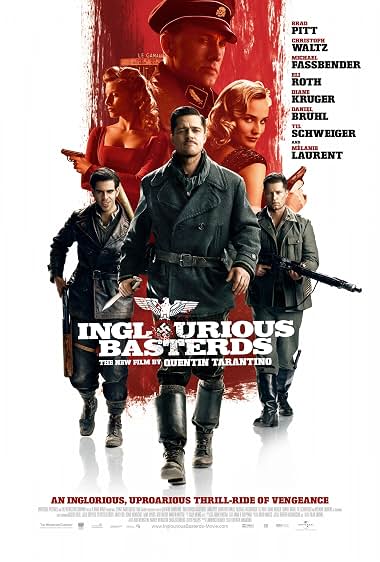
Quentin Tarantino's revisionist historical war masterpiece Inglourious Basterds is a dialogue-driven, pulse-pounding alternate-history triumph that famously rewrites the end of World War II inside a Parisian cinema. In Nazi-occupied France, Jewish refugee Shosanna Dreyfus (Mélanie Laurent) witnesses the massacre of her family by the urbane, terrifying SS Colonel Hans Landa (Christoph Waltz, who swept every major acting award on earth, including the Oscar and Cannes Best Actor). Fleeing to Paris, Shosanna assumes a new identity as a cinema proprietor and plots a lethal trap when Nazi high command selects her theater to premiere Joseph Goebbels' propaganda epic. Simultaneously, Lieutenant Aldo Raine (Brad Pitt) leads the 'Basterds'—a ruthless commando squad of Jewish-American soldiers who scalp Nazis and strike terror through the Reich. Collaborating with British intelligence officer Archie Hicox (Michael Fassbender) and German movie star double-agent Bridget von Hammersmark (Diane Kruger), the two revenge plots converge in a blazing, silver-nitrate inferno. Boasting legendary masterclass suspense scenes like the opening French farmhouse interrogation and the subterranean tavern card game, Inglourious Basterds is an unmissable cinematic triumph.

Joker
Todd Phillips' psychological character study Joker took the cinematic world by storm in 2019, winning the prestigious Golden Lion at the Venice International Film Festival and grossing over $1.074 billion to become the highest-grossing R-rated film of all time. Joaquin Phoenix delivers an astonishing, Oscar-winning transformative performance as Arthur Fleck, an impoverished, mentally fragile party clown living with his ailing mother Penny in the trash-strewn, strike-crippled streets of 1981 Gotham City. Afflicted with a neurological disorder that causes uncontrollable bursts of inappropriate laughter, Arthur is marginalized, beaten, and stripped of social services by an indifferent society. Drawing inspiration from Martin Scorsese's Taxi Driver and The King of Comedy, the film charts Arthur's chilling transformation as he guns down three abusive Wall Street businessmen on a subway, inadvertently igniting a populist anti-rich clown protest movement across Gotham. Arthur's descent into homicidal theatricality culminates in a live television confrontation with smug late-night talk show host Murray Franklin (Robert De Niro). Powered by Hildur Guðnadóttir's haunting cello score, Joker is a searing exploration of mental illness, systemic neglect, and societal collapse.