

10 Movies & Shows Like Rear Window
Finished watching Rear Window and searching for what to binge next? Here are the 10 best matching films and series with shared themes, emotional depth, and where to stream them.

Fractured memories ripple through an artificially peaceful town in Puella Magi Madoka Magica the Movie -Walpurgisnacht: Rising, Studio Shaft's long-awaited animated sequel scheduled for February 2026. Reuniting creator collective Magica Quartet alongside chief director Akiyuki Shinbo and screenwriter Gen Urobuchi, the 118-minute feature resumes directly after the shattering twist that closed 2013's cult milestone Rebellion. Returning core heroines Homura Akemi, Madoka Kaname, Sayaka Miki, Kyoko Sakura, and Mami Tomoe step back into a visually daring dark fantasy that upended modern anime conventions. Having defied cosmic law at the end of Rebellion, Homura ripped Madoka's mortal human soul out of the divine Law of Cycles to forge a carefully curated labyrinth around Mitakihara City. Inside this rewritten paradise, magical girls share sunny school corridors, peaceful afternoons, and quiet friendships insulated from the brutal despair and witch transformations that previously claimed their lives. Only Homura bears full awareness of the universe she bent to keep Madoka safe, patrolling every hairline fracture with desperate resolve. Yet manufactured bliss refuses to hold forever as buried cosmic recollections begin leaking into dreams, reflections, and sudden flashes of violence across the city. Beneath Homura's vigilant gaze, the emotionless Incubators maneuver quietly in the shadows while the dreaded apocalyptic entity Walpurgisnacht stirs in an ominous, inverted manifestation capable of tearing space-time apart. Soon Sayaka, Kyoko, and Mami begin questioning gaps in their memories, turning familiar cafés and pastel rooftops into sites of quiet psychological dread. Caught between painful agency and protective illusion, Madoka and her companions face the devastating emotional weight behind Homura's devotion and the fragile rules governing their survival. Blending surreal collage imagery with Urobuchi's bleak philosophical tension, Shinbo and Studio Shaft craft a haunting continuation rather than a tidy victory lap. For longtime followers who waited over a decade since Rebellion, this theatrical chapter marks a pivotal reckoning for the celebrated magical girl saga.

The Samurai and the Prisoner (侍と囚人) is a gripping, historically authentic Japanese Jidaigeki samurai suspense thriller that combines the moral gravity of classic Bushido literature with the airtight deduction of a classic locked-room mystery.Set in 1688 during the frosty winter of the Genroku period in the mountainous Echigo province. Inside a heavily fortified castle, a respected clan elder is discovered poisoned inside a snow-surrounded tea pavilion that was barred from the inside with no footprints leaving the perimeter. The sole person found hiding in the castle attic is Genkuro, a silent, one-armed wandering ronin who refuses to speak or plead for his life. With clan elders demanding a swift public execution, honorable magistrate samurai Jurozaemon is granted exactly thirty days to interrogate the prisoner, verify his guilt, and prevent an all-out civil war between rival retainer clans. Through fierce psychological duels across iron bars, Jurozaemon begins to suspect that the prisoner is not a ruthless assassin, but a guardian protecting an explosive secret that could shatter the Tokugawa shogunate.

David Fincher's grim, neo-noir psychological thriller Se7en is an unrelenting, atmosphere-heavy masterclass in suspense, moral rot, and cinematic dread. Set in an unnamed, perpetually rain-drenched metropolis steeped in urban decay, the film pairs weary, literate veteran detective William Somerset (Morgan Freeman) on the verge of retirement with impetuous, idealistic young detective David Mills (Brad Pitt), who has recently transferred to the city with his anxious wife Tracy (Gwyneth Paltrow). The duo investigates a terrifying series of elaborately staged, grotesque homicides orchestrated by an anonymous, meticulous serial killer known as John Doe (Kevin Spacey). Each sadistic tableau is devised to punish a practitioner of one of the seven cardinal sins: Gluttony, Greed, Sloth, Lust, Pride, Envy, and Wrath. As the detectives delve deeper into Doe's terrifying theological manifesto, Somerset's intellectual detachment and Mills's impulsive fury are pushed to their absolute breaking points. Featuring Darius Khondji's bleached, oppressive cinematography, Howard Shore's brooding musical textures, and one of the most shocking, psychologically devastating desert climax twists in cinema history, Se7en solidified David Fincher as a visionary auteur.
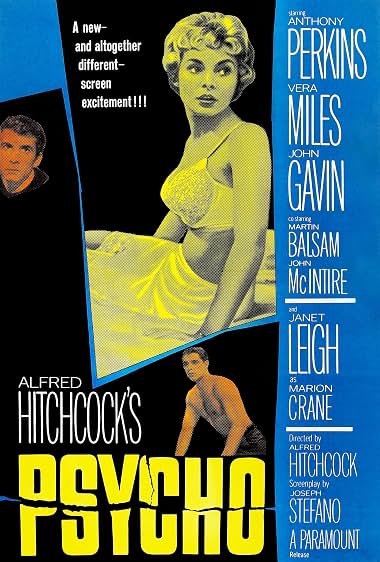
Alfred Hitchcock's 1960 psychological horror thriller Psycho obliterated the conventions of American cinema, single-handedly inventing the modern slasher genre and grossing over $50 million on a shoestring $800,000 budget. Filmed in stark, high-contrast black-and-white with his television crew, the film shocks audiences by following Phoenix secretary Marion Crane (Janet Leigh), who impulsively steals $40,000 from her employer to marry her indebted lover. Caught in a torrential rainstorm while driving to California, Marion checks into the desolate, off-highway Bates Motel, managed by the shy, bird-stuffing taxidermy enthusiast Norman Bates (Anthony Perkins in an immortal, deeply unnerving performance), who lives in an imposing gothic Victorian house with his domineering, jealous mother. In one of the most famous, revolutionary scenes in film history—the 78-piece, 45-second shower murder set to Bernard Herrmann's shrieking, jagged violin strings—Hitchcock kills off his leading lady in the first act. When Marion's sister Lila (Vera Miles) and private detective Arbogast investigate, the terrifying truth of Norman's fractured psyche and 'Mother' is unearthed, establishing Psycho as an immortal titan of terror.

Directed by Bryan Singer and brilliantly scripted by Christopher McQuarrie—who won the Academy Award for Best Original Screenplay—The Usual Suspects is universally celebrated as one of the finest, most intricately constructed neo-noir mystery crime thrillers of all time. The film opens in the smoldering, fiery wreckage of a cargo ship in the Port of Los Angeles, where 27 men have been massacred and $91 million in cocaine has mysteriously vanished. Customs agent Dave Kujan (Chazz Palminteri) interrogates one of only two survivors: Roger 'Verbal' Kint (Kevin Spacey in an Oscar-winning, career-defining performance), a meek, physically disabled small-time con artist with cerebral palsy. Through a series of mesmerizing, convoluted non-linear flashbacks, Verbal recounts how five disparate career criminals—Dean Keaton (Gabriel Byrne), McManus (Stephen Baldwin), Fenster (Benicio del Toro), Hockney (Kevin Pollak), and Verbal himself—were detained in a retaliatory New York police lineup and subsequently blackmailed into pulling off an impossible heist by Kobayashi, the inscrutable legal representative of Keyser Söze: a ruthless, ghost-like Turkish underworld kingpin whose very name strikes terror across global syndicates. Culminating in the single most legendary, breathtaking twist ending in cinematic history, The Usual Suspects is an undisputed storytelling masterclass in deception, memory, and suspense.

Written and directed with mind-bending non-linear screenwriting brilliance by Nithilan Saminathan, 2024's Tamil revenge thriller Maharaja marked superstar Vijay Sethupathi's monumental 50th career feature film, becoming an explosive commercial blockbuster grossing over ₹107 crore worldwide and a massive international streaming sensation. The narrative centers on Maharaja (Vijay Sethupathi in a career-defining tour de force of quiet stoicism, tender paternal love, and terrifying physical fury), an unassuming, middle-aged Chennai barber who lives a humble existence with his school-going daughter Jothi. Maharaja's life was scarred years earlier when a truck crashed through his home, killing his wife while an empty iron dustbin miraculously fell over infant Jothi, saving her life; consequently, the family cherishes the metal dustbin, affectionately naming it 'Lakshmi'. One day, a battered and bruised Maharaja walks into the local police station with a bizarre complaint: three masked burglars broke into his home, assaulted him, and stole 'Lakshmi' the dustbin. Mocked and dismissed by corrupt police inspectors Varadhan (Natty Natraj) and his colleagues, Maharaja refuses to leave, offering a ₹5 lakh bribe to retrieve the seemingly worthless item. As the police scheme to manufacture a fake identical dustbin to pocket the cash, Nithilan's intricate non-linear narrative reveals the horrifying, heartbreaking reality: the burglary was a cover story concealing a monstrous home-invasion sexual assault perpetrated against his teenage daughter by ruthless serial criminal Selvam (filmmaker Anurag Kashyap in a terrifying, depraved villainous role). Featuring Philomin Raj's razor-sharp editing, B. Ajaneesh Loknath's haunting score, and an emotionally gut-wrenching climax, Maharaja is a modern thriller masterpiece.

Memento is an ingenious, groundbreaking psychological neo-noir thriller written and directed by Christopher Nolan that pioneered non-linear cinematic storytelling. The story follows Leonard Shelby, portrayed with raw vulnerability and desperate focus by Guy Pearce, a former insurance claims investigator who suffers from anterograde amnesia—a condition that leaves him completely unable to create new short-term memories following a brutal home invasion in which his beloved wife was murdered. Determined to avenge his wife's death despite his debilitating memory condition, Leonard constructs an elaborate personal system of Polaroid photographs, handwritten notes, and permanent tattoos etched across his skin to keep track of critical clues and suspect descriptions. As he navigates a bleak underworld of California motels, industrial alleys, and desolate diners, Leonard crosses paths with two deeply untrustworthy figures who manipulate his vulnerability for their own agendas. Natalie, played by Carrie-Anne Moss, is a weary, sharp-minded bartender who appears sympathetic to Leonard's plight while secretly using his lethal investigative skills to eliminate her own enemies in the local drug scene. Teddy, played by Joe Pantoliano in a masterclass of nervous, fast-talking deception, poses as Leonard's cheerful friend and handler, though his conflicting instructions and suspicious motives keep the viewer constantly guessing about his true identity. Through flashbacks, Leonard recounts the cautionary tale of Sammy Jankis, played by Stephen Tobolowsky, a former amnesiac client whose tragic fate serves as a mirror for Leonard's own emotional denial. Unfolding in two alternating timelines—one moving forward in black-and-white and the other backwards in color—Memento challenges our fundamental trust in memory, identity, and personal truth, culminating in a shocking revelation that cements its status as a timeless cinema landmark.

Directed by South Korean auteur Park Chan-wook as the second and most legendary installment of his celebrated The Vengeance Trilogy, Oldboy (2003) won the Grand Prix at the 2004 Cannes Film Festival, receiving rapturous praise from jury president Quentin Tarantino and permanently cementing the global dominance of modern South Korean cinema. Loosely adapted from the Japanese manga series by Garon Tsuchiya and Nobuaki Minegishi, the narrative begins in 1988 with Oh Dae-su (Choi Min-sik in a volcanic, feral, and emotionally shattering tour de force of method acting), an ordinary, obnoxious businessman and father who is abruptly kidnapped off a rainy street and imprisoned inside a bizarre, windowless hotel room with only a television set for company. Kept alive on fried dumplings and unaware of his captor's identity or motives, Dae-su learns via the TV that his beloved wife has been brutally murdered and that he is the prime suspect. For fifteen agonizing years, Dae-su conditions his body into a lethal weapon through shadowboxing against the wallpaper, feeding an insatiable hunger for retribution. Without warning, he is suddenly released inside a suitcase on a grassy rooftop, handed cash and a mobile phone, and given exactly five days by his enigmatic, wealthy captor Lee Woo-jin (Yoo Ji-tae) to solve the mystery: not why he was imprisoned for fifteen years, but why he was let go. Aided by a sympathetic young sushi chef named Mi-do (Kang Hye-jung), Dae-su embarks on a blood-drenched odyssey through Seoul's underworld, famously culminating in the legendary three-minute single-take side-scrolling corridor brawl where Dae-su battles dozens of armed thugs with only a claw hammer. Featuring Cho Young-wuk's lush, melancholic waltz soundtrack and Chung Chung-hoon's green-tinted cinematography, Oldboy is an operatic Greek tragedy of revenge, guilt, and devastating cosmic irony.

Drishyam 2 is the globally celebrated Malayalam crime mystery thriller film streaming exclusively on Prime Video directed by Jeethu Joseph, starring Mohanlal as Georgekutty, whose family faces a renewed police investigation six years after a fateful disappearance.

The Lives of Others (original German title: Das Leben der Anderen) is an internationally acclaimed 2006 German Cold War drama written and directed by Florian Henckel von Donnersmarck in his astonishing feature directorial debut. Set in East Berlin in 1984, five years before the fall of the Berlin Wall, the film offers a brilliant, suspenseful examination of the all-pervasive surveillance apparatus operated by the Ministry for State Security (the Stasi). The narrative centers on Captain Gerd Wiesler, portrayed by Ulrich Mühe in a career-defining, heartbreaking performance. Wiesler is a dedicated, ascetic Stasi interrogator and surveillance expert who lives an empty, solitary life entirely devoted to socialist party doctrine.Wiesler is assigned to conduct comprehensive audio surveillance on Georg Dreyman, played by Sebastian Koch, a successful, seemingly loyal East German playwright, and his partner, famous actress Christa-Maria Sieland, played by Martina Gedeck. Stationed in a dusty, cold attic above Dreyman's apartment with headphones and recording equipment, Wiesler eavesdrops on every intimate conversation, argument, and artistic collaboration in the couple's life. As he discovers that the surveillance operation was initiated not for state security, but to satisfy the corrupt personal desires of Minister Hempf, Wiesler undergoes a profound internal transformation, quietly intervening to protect the artists from state destruction.Winner of the Academy Award for Best Foreign Language Film at the 79th Academy Awards, The Lives of Others is widely celebrated as one of the finest films of the twenty-first century. Now available on Amazon Prime Video in remastered high definition, the movie also stars Ulrich Tukur as ambitious Stasi Lieutenant Colonel Anton Grubitz. Florian Henckel von Donnersmarck crafts a masterwork of dramatic tension, moral redemption, and artistic freedom that honors the resilience of the human soul under totalitarian surveillance.The film's emotional depth, intellectual elegance, and unyielding defense of cultural expression make it an indispensable milestone of European historical cinema that continues to inspire audiences and film scholars across the globe.
Want to revisit the original?
Explore complete cast, director breakdown, trivia, and reviews for Rear Window.
Back to Rear Window Profile