

10 Movies & Shows Like Train to Busan
Finished watching Train to Busan and searching for what to binge next? Here are the 10 best matching films and series with shared themes, emotional depth, and where to stream them.
Avengers: Doomsday is Marvel Studios' monumental, highly anticipated superhero crossover epic that marks the beginning of the end for the Multiverse Saga, bringing together Earth's Mightiest Heroes and legendary cosmic teams to face the ultimate universal threat. As destructive multiversal incursions begin colliding alternate realities into mutual annihilation, the brilliant and ruthless monarch of Latveria, Doctor Victor von Doom, portrayed with terrifying intellectual supremacy and volcanic charisma by Robert Downey Jr., steps forward to seize cosmic power, determined to forge an unyielding new order from the ashes of fractured dimensions. The defense of reality is led by a new generation of heroic leaders and battle-hardened veterans. Sam Wilson, played with inspiring leadership and moral courage by Anthony Mackie, steps up as Captain America, rallying Earth's surviving heroes alongside the God of Thunder, Thor, played with mythic power and grief-stricken resolve by Chris Hemsworth. Joining the fray are the legendary Fantastic Four, led by Reed Richards / Mr. Fantastic, played with brilliant scientific intellect and paternal protectiveness by Pedro Pascal, and Sue Storm / Invisible Woman, played with formidable strength by Vanessa Kirby. Together with Doctor Stephen Strange, played with mystic mastery by Benedict Cumberbatch, and Shuri, played by Letitia Wright as the technologically advanced Black Panther of Wakanda, the heroes must navigate multiversal battlefields, confront alternate variants of fallen allies, and counter Doom's god-like sorcery and nano-tech armor before the timeline collapses entirely. Packed with mind-bending cosmic action, emotional character reunions, and high-stakes philosophical dilemmas about free will versus totalitarian security, Avengers: Doomsday delivers an unforgettable theatrical spectacle of historic proportions.

Ramayana: Part 1 is Nitesh Tiwari's monumental, visually magnificent mythological epic that brings the eternal Indian literary masterpiece to life with unprecedented technological scale, emotional reverence, and cinematic grandeur. The story chronicles the divine incarnation, righteous youth, and supreme moral trials of Lord Rama, portrayed with transcendent serenity, noble physical grace, and gentle wisdom by Ranbir Kapoor. As the beloved eldest prince of Ayodhya, Rama embodies the highest ideals of dharma, duty, and filial obedience in the ancient solar dynasty. The first chapter of this epic trilogy explores the idyllic golden age of Ayodhya under King Dasharatha and the sacred swayamvara in Mithila, where Rama wins the hand of Goddess Sita, portrayed with radiant grace, spiritual strength, and profound dignity by Sai Pallavi. Their tender, pure bond becomes the moral foundation of the entire saga. However, courtly harmony is shattered when Queen Kaikeyi, manipulated by the venomous whispers of maid Manthara, demands Dasharatha fulfill ancient boons by banishing Rama to a fourteen-year forest exile and placing her son Bharata on the throne. Upholding his father's honor without hesitation, Rama departs for the wilderness accompanied by Sita and his fiercely loyal brother Lakshmana, trading royal silk for ascetic bark garments. In the dense jungles of Panchavati, their peaceful hermitage is threatened when the demoness Surpanakha attempts to kill Sita, sparking an escalating conflict with the demonic forces of Lanka. The epic reaches its devastating turning point with the arrival of Demon King Ravana, played with imposing physical majesty, ten-headed intellectual arrogance, and terrifying power by Yash, whose treacherous abduction of Sita sets the stage for the greatest war in cosmic history. With state-of-the-art VFX from DNEG, majestic musical compositions by A. R. Rahman and Hans Zimmer, and timeless spiritual depth, Ramayana: Part 1 is a cultural milestone celebrating righteousness, devotion, and supreme courage.
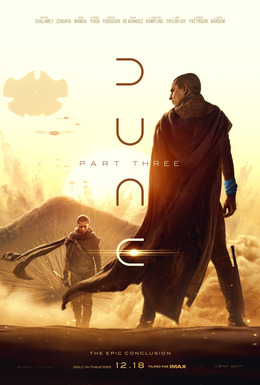
Dune: Part Three is Denis Villeneuve's grand, earth-shattering cinematic conclusion to Frank Herbert's epic Dune trilogy, bringing the tragic destiny of Paul Atreides and the fate of Arrakis to its monumental climax. Set against the backdrop of an empire torn apart by religious fanaticism, ecological transformation, and brewing palace treason, the film explores the agonizing psychological toll of absolute power and the devastating cost of fulfilling divine prophecy. Paul Atreides, portrayed with haunting intensity, physical frailty, and terrifying prescience by Timothée Chalamet, finds his imperial court on Arrakis surrounded by unseen enemies. Chani, played with fierce warrior independence and heartbreaking grief by Zendaya, struggles to protect her newborn royal twins from Bene Gesserit schemers and Fremen zealots who view the children as holy relics rather than human beings. Princess Irulan, played with calculating intellect and suppressed sympathy by Florence Pugh, must decide whether to support the conspiracy to overthrow Paul or protect his legacy from complete annihilation. When a devastating atomic weapon known as a stone burner is detonated during an assassination attempt, blinding Paul physically, his prescient sight allows him to see the horrific future awaiting humanity unless he breaks the cycle of his own myth. With the aid of a resurrected ghola of his beloved mentor Duncan Idaho, played by Jason Momoa, and his fiercely prescient sister Alia, played by Anya Taylor-Joy, Paul makes the ultimate, tragic sacrifice, walking alone into the deep desert wastes as a blind nomad to leave the empire in the hands of his children and free the universe from his godhood. Featuring awe-inspiring desert visuals, thunderous sound design, and deeply moving dramatic performances, Dune: Part Three stands as a crowning achievement in cinematic science fiction.

The Last Horizon is an exhilarating cinematic adventure that takes audiences across the vast, unforgiving desert frontier in search of humanity's forgotten origins. Set in a near future where water has become the planet's rarest currency, the story centers on Nathan Drake, played with weathered grit and quiet optimism by Tom Hanks. Nathan is a veteran cartographer and desert explorer who has spent his life tracing ancient satellite anomalies to locate the legendary lost city of Irem, a mythical settlement rumored to hold a clean geothermal water reservoir capable of reviving desolate lands. Nathan is joined on his perilous expedition by Elena Vance, played with fierce intellect, scientific determination, and physical bravery by Emma Watson. As an environmental archaeologist, Elena believes the lost civilization was brought down by climate catastrophe rather than warfare, searching for cultural records that can teach modern survivors how to restore dying ecosystems. Along their journey through scorching dunes and razor-sharp sandstorms, the pair is guided by Silas, played with enigmatic charm and questionable loyalties by Cillian Murphy, a desert nomad and former military engineer who knows the shifting terrain better than anyone. Complicating their mission is Maya, portrayed by Florence Pugh, the ruthless leader of a motorized scavenger syndicate determined to plunder the ancient sanctuary for weapons technology. Through pulse-pounding vehicle chases across salt flats, underground labyrinth explorations, and breathtaking visual landscapes, the travelers learn that true survival depends on cooperation and environmental respect rather than brute force. With stunning practical cinematography, realistic survival dynamics, and an emotionally uplifting message about conservation, The Last Horizon delivers a sweeping cinematic journey of courage and rediscovery.
Dune: Messiah Part 1 is Denis Villeneuve's grand, tragic continuation of Frank Herbert's epic science fiction saga, chronicling the devastating consequences of charismatic leadership, galactic holy war, and supreme political power. Set twelve years after the events of Dune: Part Two, the story finds Paul Atreides, portrayed with haunting gravitas, intellectual burden, and prophetic torment by Timothée Chalamet, ruling as the undisputed Emperor of the Known Universe from his colossal fortress on the desert planet Arrakis. However, the golden empire Paul envisioned has transformed into a living nightmare: the Fremen legions have unleashed a savage religious jihad across the stars in his name, claiming billions of lives despite his desperate efforts to control the fanaticism. Paul finds solace only in the company of Chani, played with profound emotional strength and tragic devotion by Zendaya, who remains his true love and moral compass while struggling to conceive an imperial heir. Meanwhile, Paul's formal political wife, Princess Irulan, played with calculating intellect and suppressed longing by Florence Pugh, joins a clandestine conspiracy with the displaced Bene Gesserit Sisterhood, led by Lady Jessica (Rebecca Ferguson) and Reverend Mother Mohiam, to neutralize Paul's bloodline before his prophetic visions reshape reality permanently. Adding to the intrigue is Alia Atreides, played with chilling divine fury by Anya Taylor-Joy, Paul's adult sister whose terrifying prescient abilities make her an unpredictable force in court politics. As a resurrected clone (ghola) of Paul's fallen mentor Duncan Idaho, played by Jason Momoa, arrives as an ambiguous gift, Paul must navigate an intricate web of poison, atomic plots, and religious fanaticism, knowingly walking toward a blinding destiny to free humanity from the myth of Muad'Dib. With its breathtaking visual architecture, Hans Zimmer's haunting musical themes, and deeply philosophical storytelling, Dune: Messiah Part 1 promises an unforgettable cinematic achievement.

Wartime trauma lingers over Tokyo's fragile reconstruction in Godzilla Minus Zero, the eagerly awaited direct follow-up to Godzilla Minus One from writer, director, and visual-effects supervisor Takashi Yamazaki. Scheduled for release in November 2026, this 135-minute kaiju drama reunites Ryunosuke Kamiki as former kamikaze pilot Koichi Shikishima and Minami Hamabe as resilient partner Noriko Oishi. Drawing solemn historical inspiration from the 1954 original, Yamazaki widens both the intimate family stakes and the existential peril looming across Japanese waters. Picking up in 1954 as bomb-scarred neighborhoods clear away rubble and families strive toward modern stability, Koichi pours his energy into raising young Akiko and tending an ordinary household alongside Noriko. That hard-won calm cracks open when oceanographers dredging the chilly depths of Tokyo Bay haul up biological tissue exhibiting frighteningly rapid cellular regeneration. At the same time, Chief Mechanic Tachibana and naval observers begin noting unexplained underwater tremors disturbing shipping lanes far beyond Japan's coastal defenses. Closer to home, Noriko struggles with worsening fatigue and disturbing symptoms radiating from the dark, ink-like mark left on her neck after the earlier catastrophe. Medical uncertainty plunges Koichi back into dread just as deep-sea seismic buoys detect an immense thermal signature surging southward out of frozen Pacific trenches. Larger, deadlier, and violently mutated, the returning atomic leviathan threatens to erase every modest gain postwar survivors fought so fiercely to protect. With geopolitical tensions tying up formal military intervention, traumatized citizens, veteran flyers, and stubborn dockyard engineers must once again improvise a desperate line of defense. Grounding towering maritime spectacle in guilt, devotion, and working-class grit, Yamazaki builds continuity straight from his breakthrough Oscar-winning chapter without repeating its exact formula. Godzilla Minus Zero frames monster mayhem not as distant popcorn noise, but as an unforgiving reckoning with survival in the nuclear shadow.

Jai Bhim (2021) is an unflinching Tamil courtroom drama written and directed by T. J. Gnanavel, drawing directly from a real 1993 legal battle fought in Tamil Nadu. Rather than centering on commercial heroics, the story opens inside the daily lives of the marginalized Irula tribal community, who earn meager wages catching venomous snakes and field rats without caste certificates, land deeds, or basic legal protection. When jewelry goes missing from an influential village household, local police frame innocent laborer Rajakannu (K. Manikandan) and subject him and his relatives to brutal custodial torture before falsely claiming he escaped detention. Refusing to accept the fabricated police report, Rajakannu’s pregnant wife Sengeni (Lijomol Jose) seeks help from Suriya’s Advocate K. Chandru, a principled human rights lawyer known for taking on unpaid cases for the dispossessed. Chandru files a rare habeas corpus petition in the Madras High Court, triggering a tense, methodical investigation led alongside an honest senior police officer (Prakash Raj) to dismantle the state’s cover-up. As threats, forged documents, and witness intimidation mount, the legal battle becomes a crucial test of whether constitutional safeguards can hold violent officials accountable. Gnanavel keeps the tone austere and procedural, letting S. R. Kathir’s grounded camerawork and Sean Roldan’s restrained score frame the courtroom arguments with quiet urgency. Suriya deliberately steps back from star-vehicle theatrics, allowing Lijomol Jose’s heartbreaking resilience as Sengeni and Manikandan’s understated dignity to form the emotional core of the film. Released digitally in November 2021 to overwhelming critical acclaim, Jai Bhim sparked nationwide conversations around custodial violence and tribal rights, earned Golden Globe eligibility, and saw one of its scenes featured in the Academy’s official "Scene at the Academy" showcase. Alongside Soorarai Pottru, it marked a defining chapter in Suriya’s career as both actor and producer.

Directed by visionary Indian filmmaker S. S. Rajamouli, RRR is a sweeping 2022 Telugu-language action epic that imagines a fictional friendship between two real-life twentieth-century revolutionaries during the height of British colonial rule. Set largely in 1920s Delhi, the film stars Ram Charan as Alluri Sitarama Raju and Jr NTR as Komaram Bheem, pairing mythic scale and exuberant musicality with breathless kinetic momentum across a three-hour canvas of rebellion and brotherhood. The conflict ignites when ruthless British Governor Scott Buxton and his wife abduct Malli, a gifted young girl from the Gond tribe, forcing her protector Bheem to travel undercover to Delhi in hopes of rescuing her. Unaware of Bheem's secret mission, disciplined imperial police officer Raju—privately working toward an armed Indian uprising from within the British ranks—accepts the assignment to capture the elusive tribal outsider. When the two strangers unite spontaneously to pull a trapped boy from a burning train wreck beneath a raging river bridge, an exuberant brotherhood blossoms before duty and hidden loyalties force them onto opposite sides of a deadly manhunt. Rounding out the ensemble, Alia Bhatt portrays Raju's devoted fiancée Sita, Ajay Devgn appears in an emotional flashback as freedom fighter Venkata Rama Raju, Shriya Saran plays Raju's mother Sarojini, Olivia Morris portrays sympathetic British aristocrat Jenny, and Ray Stevenson and Alison Doody embody the imperious colonial governors. Blending operatic melodrama, jaw-dropping practical and digital stunt choreography, and earnest camaraderie, Rajamouli balances wild theatricality with genuine heartbreak whenever brotherhood collides with revolutionary sacrifice across palace raids and forest ambushes. Following his monumental two-part saga Baahubali: The Beginning and Baahubali 2: The Conclusion, Rajamouli's March 2022 theatrical release became a breakout international sensation across North America, Japan, and Europe. Powered by M. M. Keeravani's rousing score, K. K. Senthil Kumar's vivid widescreen photography, Sabu Cyril's grand period production design, and the infectious dance sequence "Naatu Naatu," the film earned historic international honors and reshaped global curiosity toward Indian popular cinema.
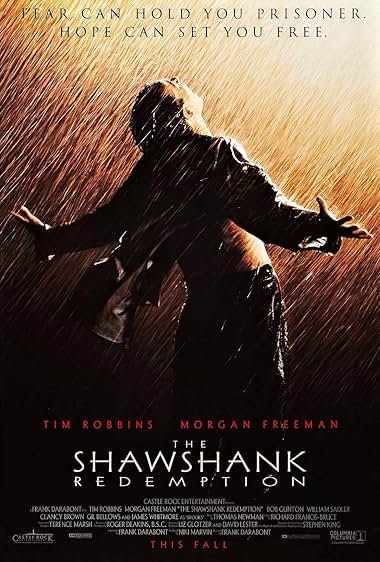
Consistently voted by film lovers worldwide as the greatest movie ever made on the IMDb Top 250, Frank Darabont's The Shawshank Redemption is a transcendent, deeply inspiring dramatic tour de force adapted from Stephen King's beloved novella Rita Hayworth and Shawshank Redemption. The film follows Andy Dufresne (Tim Robbins), a quiet, cerebral New England banker who is wrongfully convicted of the brutal double murder of his adulterous wife and her lover in 1947 and sentenced to two consecutive life terms inside the grim, monolithic walls of Shawshank State Penitentiary in Maine. Over two decades of soul-crushing incarceration, Andy endures sadistic beatings from inmates and institutional cruelty from the hypocritical, bible-thumping Warden Samuel Norton and sadistic Captain Byron Hadley. Rather than surrendering to despair, Andy preserves his inner dignity, utilizing his sharp financial acumen to gain protection and orchestrating an underground library for his fellow prisoners. He forms an immortal, life-affirming bond of brotherhood with Ellis 'Red' Redding (Morgan Freeman in his definitive, soulful role as narrator and contraband procurer). A majestic meditation on resilience, redemption, patience, and the unquenchable power of the human spirit, the film's euphoric, rain-drenched climax remains cinema's ultimate symbol of freedom.

Written and created by Craig Mazin and directed with suffocating tension by Johan Renck, HBO and Sky UK's five-part historical miniseries Chernobyl is a harrowing, astonishingly detailed autopsy of the worst man-made nuclear disaster in human history. In the early morning hours of April 26, 1986, Reactor No. 4 at the Chernobyl Nuclear Power Plant in Soviet Ukraine violently explodes during an unauthorized safety test, exposing the radioactive core to the atmosphere and sending deadly fallout across Europe. Jared Harris delivers a tour-de-force, quiet performance as Valery Legasov, an honest inorganic chemist who is paired with Soviet Deputy Prime Minister Boris Shcherbina (Stellan Skarsgård) and tireless Belarusian nuclear physicist Ulana Khomyuk (Emily Watson) to contain the catastrophe. The series exposes not only the horrifying physical brutality of acute radiation sickness endured by heroic firefighters and coal miners, but the even more lethal radiation of bureaucratic denial, state secrecy, and institutional cowardice under the Soviet regime. Winner of ten Primetime Emmy Awards and boasting Hildur Guðnadóttir's chilling industrial soundscapes recorded inside an actual decommissioned nuclear plant, Chernobyl is an unforgettable warning on the cost of political deception.
Want to revisit the original?
Explore complete cast, director breakdown, trivia, and reviews for Train to Busan.
Back to Train to Busan Profile